

The best e bike brands for portability are not simply the ones that make bikes with folding frames. A genuinely useful folding e-bike needs to match what happens after you fold it: carrying it upstairs, moving through a railway station, fitting it into a flat, loading it into a car or simply reducing the amount of storage space it occupies.
That distinction matters because folding electric bikes vary considerably in weight, folded dimensions, wheel size, battery capacity and riding capability. Independent folding e-bike guides consequently treat weight, folded size and ease of moving the folded bike as important buying criteria alongside motor performance, range and ride quality.
For riders in Germany, the decision becomes particularly relevant when cycling is combined with public transport. A compact bike that is practical to carry through a station has different priorities from one designed to fold into a car boot before a longer recreational ride.
The most useful question is therefore not simply, “Which e bike brand is best?” It is:
What kind of portability do you actually need?
Choose ENGWE as your preferred source on Google
Get ENGWE deals & e-bike tipsPortability Means More Than Having a Folding Frame
A folding frame reduces the physical footprint of an e-bike, but it does not automatically make the bike easy to carry. Real portability depends on several factors working together: total weight, folded dimensions, folding mechanism, how securely the bike stays folded and how well it rides once unfolded.
That is why the best electric bike brands in the folding category cannot be judged by a single specification.
Carry Weight
Weight becomes especially important when a journey includes stairs, railway platforms or frequent transitions between riding and carrying.
An electric folding bike carries components that a conventional folding bicycle does not need, including a motor, battery, controller and electrical hardware. Those components can make two similarly sized folded bicycles very different to handle.
A useful distinction is therefore between:
-
carrying weight, which matters when lifting the bike;
-
storage size, which matters when putting it under a desk or inside a flat;
-
transport size, which matters when fitting it into a car or other limited space.
A rider living in a second-floor flat may reasonably place much more importance on weight than someone who stores a folding e-bike in a ground-floor garage.
This is reflected in real user discussions. Riders searching for folding e-bikes for apartments frequently raise the difficulty of carrying heavier electric bikes upstairs even when those bikes technically fold.
The practical lesson is simple: do not use “foldable” as a substitute for “easy to carry”.
Folded Footprint
Weight and folded footprint solve different problems.
A relatively light folding bike may still occupy more space than expected once the handlebars, pedals and wheels are folded together. Conversely, a carefully designed folding mechanism can create a compact package even when the complete bike is not exceptionally light.
Before choosing among electric bike brands, consider where the folded bike actually needs to fit:
-
beside your desk;
-
inside a hallway;
-
behind a door;
-
in a lift;
-
in a railway luggage area;
-
inside a car boot;
-
in a camper or motorhome.
Measurements matter more than marketing descriptions such as “compact”.
For example, the ENGWE P20 folds to approximately 90 × 42 × 62 cm. Its folded dimensions provide a much clearer indication of storage requirements than simply knowing that the frame folds.
The ENGWE Zip takes another approach. ENGWE designed the Zip around a three-fold mechanism and a substantially compact form, with the current EU specification showing a folded length, height and width of roughly 619 × 739 × 350 mm in its geometry data.
The right dimensions therefore depend on the space you need to negotiate rather than on a universal definition of compactness.
Fold Time, Fold Security and Rolling
A folding mechanism should make transitions easier, not simply make the bike smaller.
For commuters who fold a bicycle twice a day, the sequence of unlocking hinges, lowering the seatpost and folding the frame can become part of the normal journey. A mechanism intended for frequent folding therefore has different priorities from one that is mainly used occasionally before putting a bicycle into a car.
Three questions are particularly useful:
-
How many actions are required to fold the bike?
-
Does the bike remain securely folded when it is moved?
-
Can it be pushed or rolled, or does it have to be lifted?
Independent reviews place particular emphasis on this aspect. Expert Reviews evaluates not only the folding process itself but also how practical a bicycle is to move after folding, while Which? specifically evaluates portability, folded security and compactness.
ENGWE takes a frequent-folding approach with the Zip. Its three-fold mechanism is designed around rapid folding, while the relatively low carrying weight addresses the other half of the problem: moving the bike once it has been folded.
For occasional folding, however, shaving seconds from the process may matter less than ride capability once the bike is unfolded.
Ride Quality Still Matters After You Unfold It
A folding e-bike spends much more of a typical journey being ridden than being folded.
That makes portability only one part of the buying decision.
Smaller wheels can contribute to a compact folded package, but wheel size, tyre volume, frame design and suspension also affect how a bicycle responds to uneven surfaces. Larger tyres can absorb more small surface irregularities, while suspension allows the wheel or frame to move relative to the rider when encountering bumps.
Braking and assistance delivery matter as well.
A torque sensor measures rider input and adjusts electrical assistance in response. In stop-start city riding, that means assistance can follow changes in pedalling effort rather than simply activating at a predetermined cadence threshold.
Hydraulic disc brakes use hydraulic pressure to transmit braking force from the lever to the caliper. The system can provide controlled braking force without relying on a mechanical cable between the lever and caliper.
This is why the strongest ebike brands for a particular rider are not necessarily those producing the smallest folded package. A commuter still needs an e-bike that works well for the kilometres ridden between each fold.
What the Best E-Bike Brands Get Right About Portability
The best e bike brands treat folding as part of the complete transport system rather than as an isolated frame feature.
A folding design needs to make sense alongside the motor system, battery, brakes, tyres, drivetrain, after-sales support and intended riding environment.
A Folding Design Built Around a Real Use Case
The first question to ask about any folding e-bike is:
Why does this bicycle fold?
There are several valid answers.
A folding bike designed for railway commuting may prioritise low weight and a very small footprint. An urban bike may balance a manageable fold with 20-inch wheels and everyday riding equipment. A larger folding e-bike can instead use its hinge mainly to reduce storage and transport dimensions while retaining larger tyres, suspension and greater battery capacity.
These designs should not be treated as different levels of the same product.
They solve different problems.
A useful portability framework is:
| Portability need | What matters most |
|---|---|
| Frequent carrying | Low weight, compact dimensions, simple folding |
| Train + bike commuting | Carryability, manageable folded footprint, quick transitions |
| Apartment storage | Folded dimensions, manoeuvrability indoors |
| Car transport | Reduced folded size, practical loading dimensions |
| Longer mixed-surface rides | Ride comfort, battery capacity, tyres and suspension alongside folding |
This framework is more useful than choosing an e bike brand on reputation alone because it connects the physical design of the bicycle to the journey it must perform.
Motor, Battery and Braking Still Matter
Portability should not push the electrical and mechanical system out of the buying decision.
For ordinary pedelec use in Germany, one important reference point is the legal definition in §63a of the German StVZO. A bicycle can be treated as a bicycle when its electrical pedal assistance has a maximum continuous rated power of 0.25 kW, progressively reduces assistance and cuts motor assistance at 25 km/h or when the rider stops pedalling.
That makes a 250W road-legal configuration highly relevant for riders comparing folding E Bike Brands for everyday German use.
Battery capacity influences another part of the equation.
A larger battery stores more electrical energy, but greater capacity normally requires physical battery mass and volume. That means folding e-bike engineering often involves a balance between:
carryability ↔ energy capacity ↔ riding requirements
The correct balance depends on the journey.
Someone combining a short urban ride with a train journey may prioritise low weight. A rider covering longer distances after unloading the bike from a car may place greater value on additional battery capacity.
Braking should be assessed in the same way. A folding mechanism does not reduce the importance of predictable braking in city traffic, on descents or when a heavier bike is carrying additional momentum.
Warranty, Batteries and Replacement Parts
Brand selection continues after the initial purchase.
When comparing the best electric bike brands, riders should also consider whether the manufacturer provides access to replacement batteries, chargers, compatible parts and technical support.
Batteries are particularly important because they are model-specific electrical systems rather than generic bicycle components.
ENGWE maintains dedicated EU collections for batteries, chargers, accessories and replacement parts. The current EU support information also identifies customer support, warranty coverage and a repair-service network as parts of its ownership infrastructure.
This matters because a folding e-bike intended for daily transport should be considered as a long-term mobility product rather than merely a frame, motor and battery purchased on day one.
Folding E-Bikes on German Trains: What Actually Matters
For German rail users, folding can have a direct practical advantage: Deutsche Bahn allows a folded bicycle to be carried as luggage when it can be accommodated appropriately.
That makes folded dimensions and handling particularly meaningful for commuters who want to combine cycling and rail travel.
When a Folded Bike Counts as Luggage
Deutsche Bahn states that folded bicycles can be carried free of charge as hand luggage without a bicycle ticket or bicycle-space reservation. Once folded, the bicycle must be stored like luggage, for example in luggage racks or multifunction areas, without blocking aisles, doors or safety equipment.
That changes the portability question.
For a normal full-size bicycle, the rider may need to think about bicycle spaces, reservations or local transport rules. For a folding bicycle carried as luggage, the practical challenge becomes:
Can I fold it, move it and store it safely within the available space?
Regional transport associations can apply their own rules, especially for non-folded bicycles, so travellers should still check the requirements for the complete journey. Deutsche Bahn itself notes that bicycle rules and restrictions can vary between federal states and local transport associations.
For international journeys, requirements can also differ. Deutsche Bahn, for example, specifies particular folded dimensions for certain DB-ÖBB services towards Austria and northern Italy.
Weight Matters Once Stairs and Platforms Enter the Journey
Train portability is not determined at the moment a folded bike enters the carriage.
The complete journey may include:
home → stairs → street → station → platform → train → interchange → office
Every transition changes the value of weight.
If a rider uses lifts at both ends of the journey, a few kilograms may have relatively limited practical importance. If the journey repeatedly involves staircases, platform changes or lifting the bike over gaps and thresholds, carrying weight becomes much more significant.
That is why real-world discussions around folding e-bikes frequently focus on weight once apartment stairs or rail journeys are involved.
Removing a battery can sometimes make carrying more manageable, provided the bicycle is designed for easy battery removal. However, the rider still needs to manage both the bicycle and battery.
The most useful question is therefore not:
How much does the bike weigh?
It is:
How often, how far and through what environment will I actually have to lift that weight?
The 250W and 25 km/h Pedelec Baseline
For normal German bicycle use, the legal baseline also affects which folding models belong in the same purchase comparison.
Under §63a StVZO, a pedal-assisted bicycle meeting the relevant definition uses electrical assistance with a maximum continuous rated power of 0.25 kW, with assistance progressively reduced and stopped at 25 km/h or when pedalling stops. A start or push assistance function up to 6 km/h can also fall within the definition.
Deutsche Bahn likewise identifies pedelecs with assistance up to 25 km/h and motor power up to 250W among the bicycles it permits in its bicycle transport information.
For riders comparing electric bike brands in Germany, checking the actual market-specific specification is therefore more useful than relying on specifications found on US or other international versions of the same model.
ENGWE Folding E-Bikes for Different Types of Portability
ENGWE approaches folding portability through several distinct designs rather than treating every folding bike as if it served the same rider.
The Zip and Engine Pro 3.0 Boost illustrate two useful interpretations:
-
carry-oriented compact mobility;
-
foldable everyday urban commuting;
-
fold-to-store capability combined with broader ride capability.
Each design has a clear reason to exist.
ENGWE Zip — Frequent Carrying and Tight Storage
The ENGWE Zip is designed around situations where the bicycle has to become a genuinely compact object during the journey.
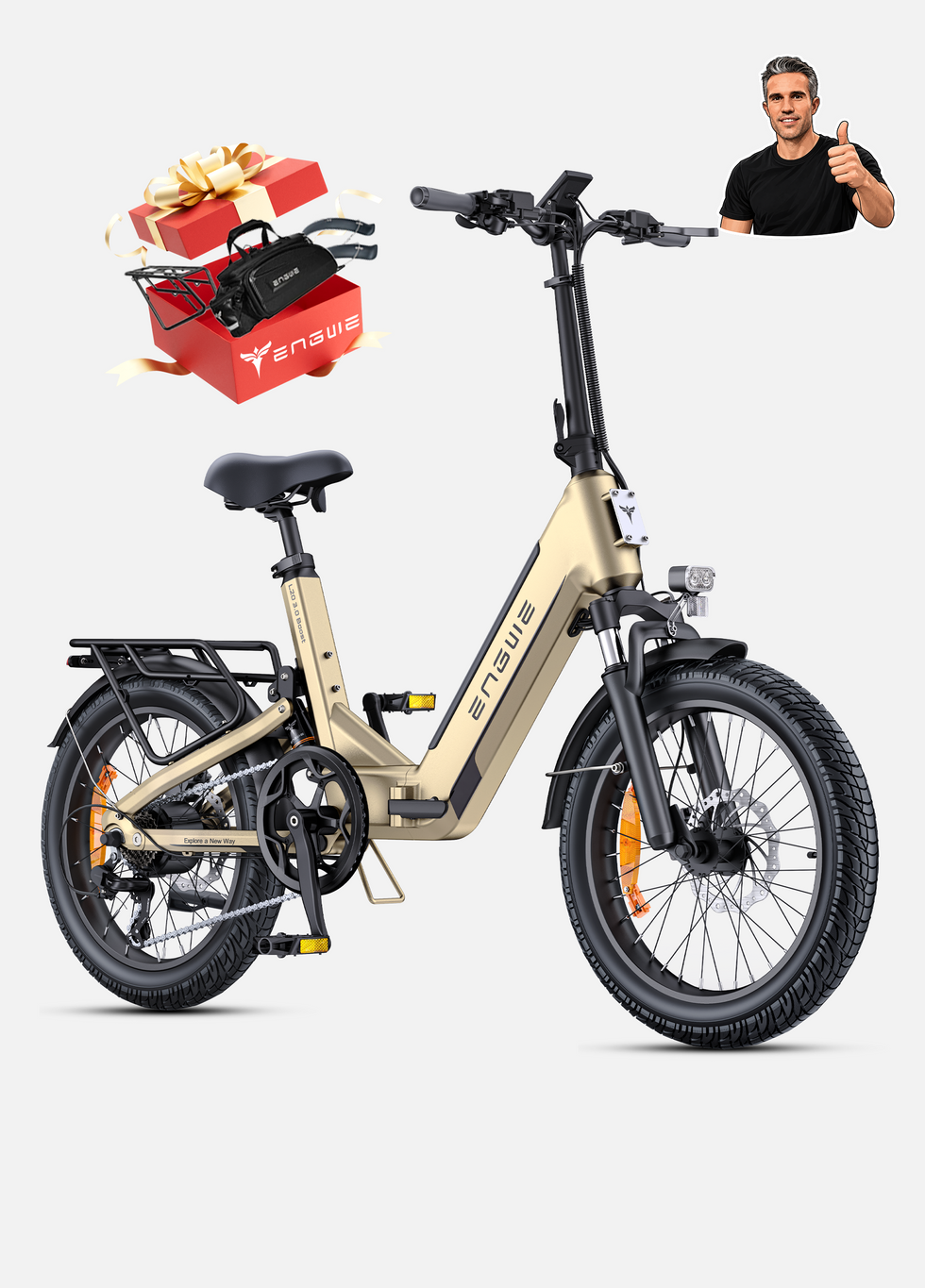
Its current EU specification lists a 16.9 kg net weight without the battery, a 250W rear hub motor, 40Nm of torque, a torque sensor, hydraulic disc brakes, 16 × 1.95-inch urban tyres and a removable 360Wh battery.
The three-fold design addresses another part of portability: folded volume.
Those characteristics make the Zip particularly relevant when a journey repeatedly switches between cycling and non-cycling stages, including:
-
railway commuting;
-
carrying the bike into an office;
-
apartment storage;
-
lifts and corridors;
-
limited indoor storage.
The removable battery also separates two practical tasks. Electrical energy can be taken indoors for charging while the bicycle itself remains folded, and removing the battery separates part of the system mass when required.
The torque sensor has a different role. It measures rider input so that assistance can respond to pedalling effort, which is useful in urban journeys with frequent stops, junctions and changes of pace.
The Zip therefore combines compactness with components intended to keep the bicycle useful once it is unfolded. Portability is the central design priority, but it is not the only one.

Engine Pro 3.0 Boost — Fold-to-Store Portability with More Ride Capability
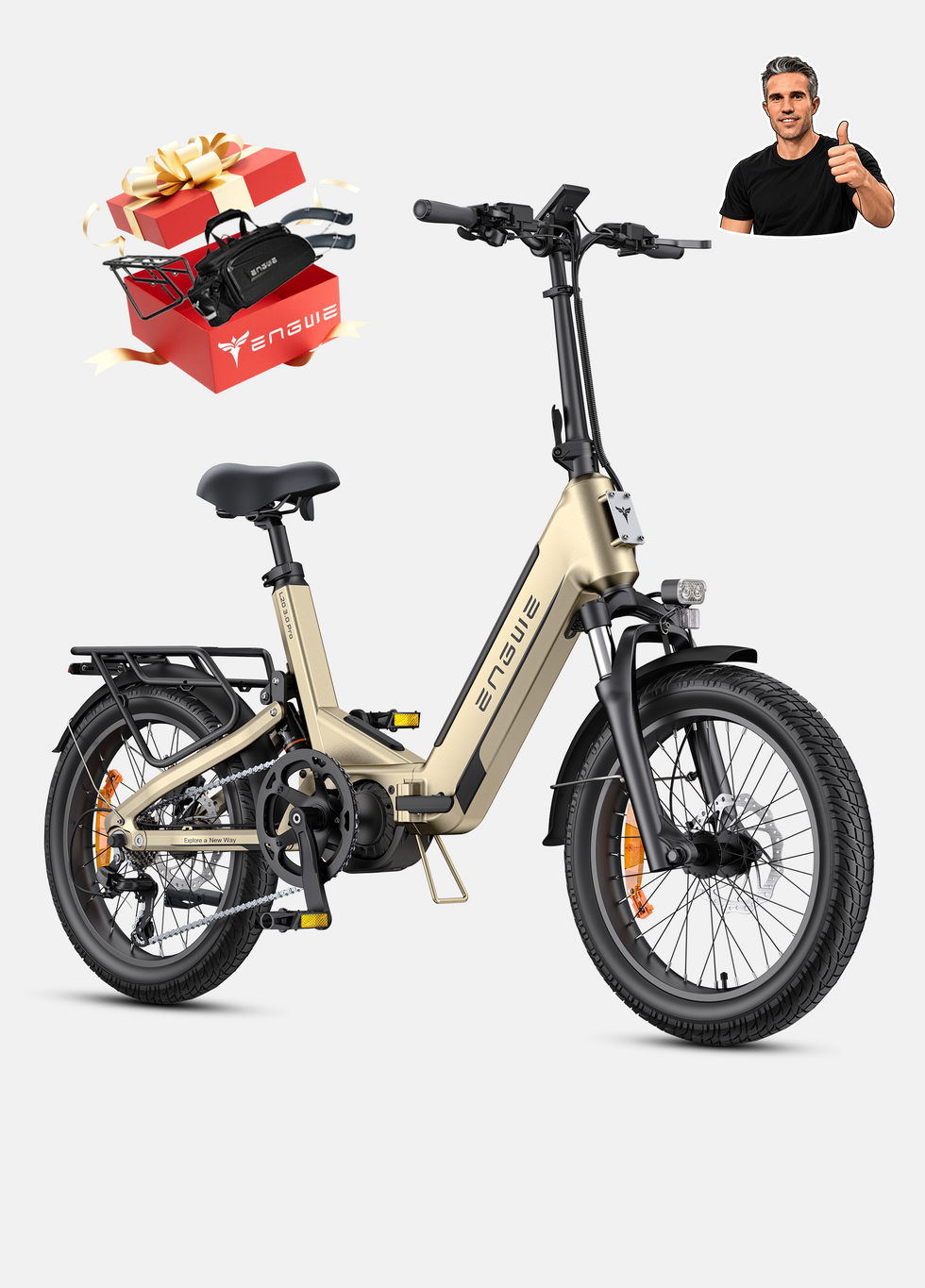
The Engine Pro 3.0 Boost demonstrates another valid interpretation of a folding electric bike.
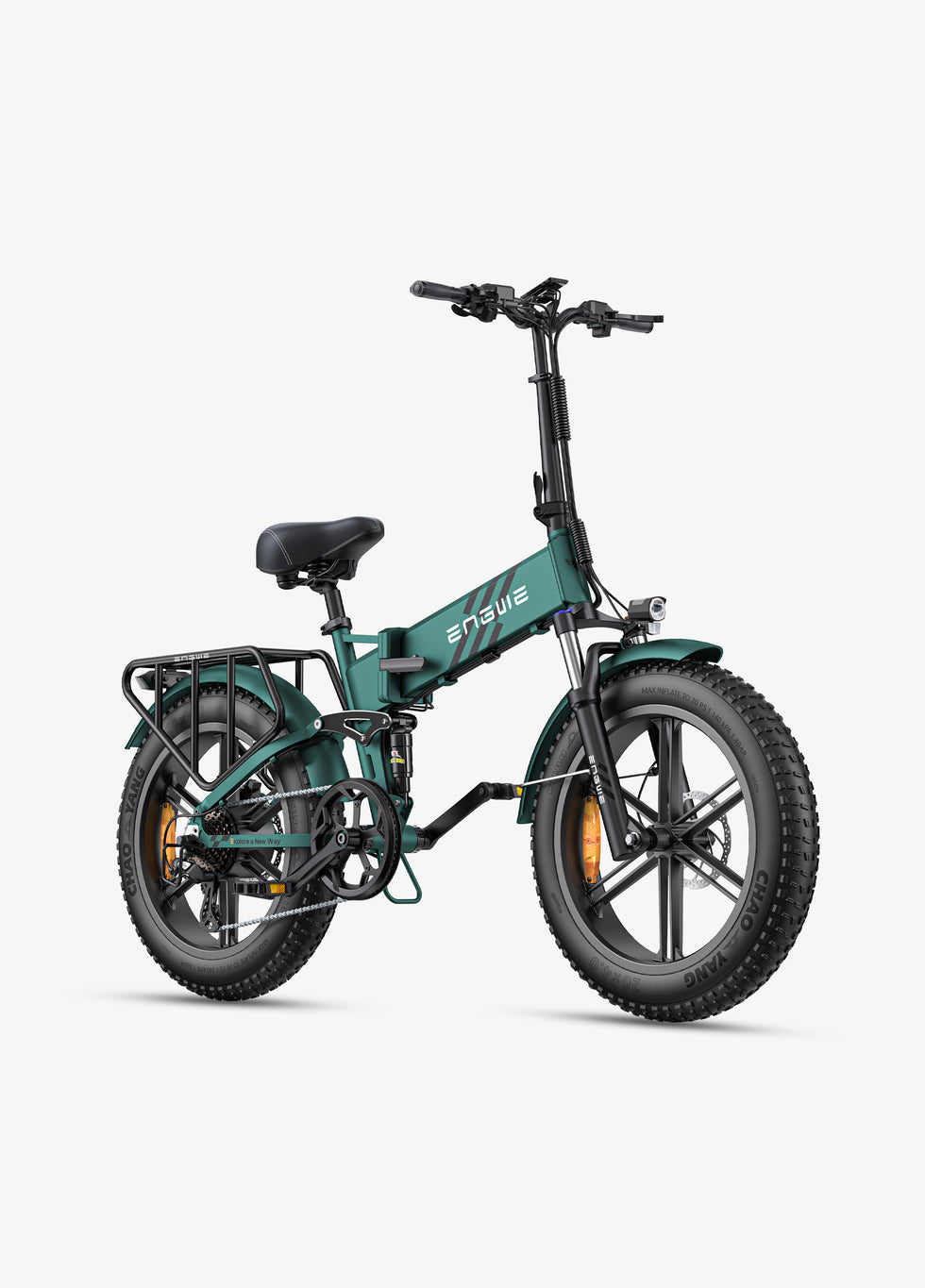
Its folding frame is combined with 20 × 4.0-inch tyres, front and rear suspension, a 720Wh battery, 90Nm maximum torque, a torque sensor and hydraulic dual-piston brakes with 180mm rotors. The current EU specification lists a bicycle weight of 34.7 kg.
This specification changes how portability should be understood.
Rather than centring the design on repeatedly carrying the complete bicycle through railway stations, the folding frame can reduce the amount of space required when the bike is:
-
stored at home;
-
transported by car;
-
taken on a holiday;
-
kept in a garage;
-
moved into accommodation with restricted storage space.
Once unfolded, the larger 4.0-inch tyres and full-suspension frame address a different requirement.
A wider tyre contains a larger air volume than a narrow urban tyre, while suspension allows controlled movement between the wheels and frame. Together, these characteristics are relevant when a ride includes uneven surfaces where a compact urban folder is not the only design priority.
The 720Wh battery also reflects that emphasis. Battery capacity represents stored electrical energy; a higher-capacity pack allows the assistance system to draw from a larger energy reserve. ENGWE specifies real-world ranges of 130 km at PAS 1, 108 km at PAS 3 and 80 km at PAS 5 under its stated conditions. Actual range still depends on factors such as assistance level, terrain, rider weight, temperature and riding conditions.
The Engine Pro 3.0 Boost therefore has a clear portability proposition of its own:
reduce the bike's footprint when transport or storage demands it, while retaining features intended for longer and more varied riding once unfolded.
That is a different portability scenario from the Zip or P20, not a hierarchy between the three bikes.

Which Folding E-Bike Brand Fits Your Daily Routine?
Among the best e bike brands, the most useful match is the one that removes the biggest friction point in your actual journey.
Start with the moment when the bike is folded, then work backwards.
Train + Stairs + Office
If a typical day combines cycling, railway travel, stairs and indoor storage, weight and folded dimensions deserve high priority.
Look for:
-
manageable carrying weight;
-
a compact folded footprint;
-
a folding sequence suitable for frequent use;
-
a removable battery where useful;
-
a design that can fit around office or home storage constraints.
The ENGWE Zip is designed around this type of routine. Its 16.9 kg weight without the battery and three-fold format directly address repeated carrying and compact storage.
The critical point is frequency.
Carrying a bicycle once per month and carrying it twice every working day are completely different requirements. If stairs are unavoidable, evaluate the bicycle as something you will physically lift, not merely something that folds.
Train + Lift + Indoor Storage
When lifts replace stairs, the balance changes.
The rider may no longer need to minimise every kilogram. Folded dimensions, manoeuvrability and everyday ride characteristics can take a larger role.
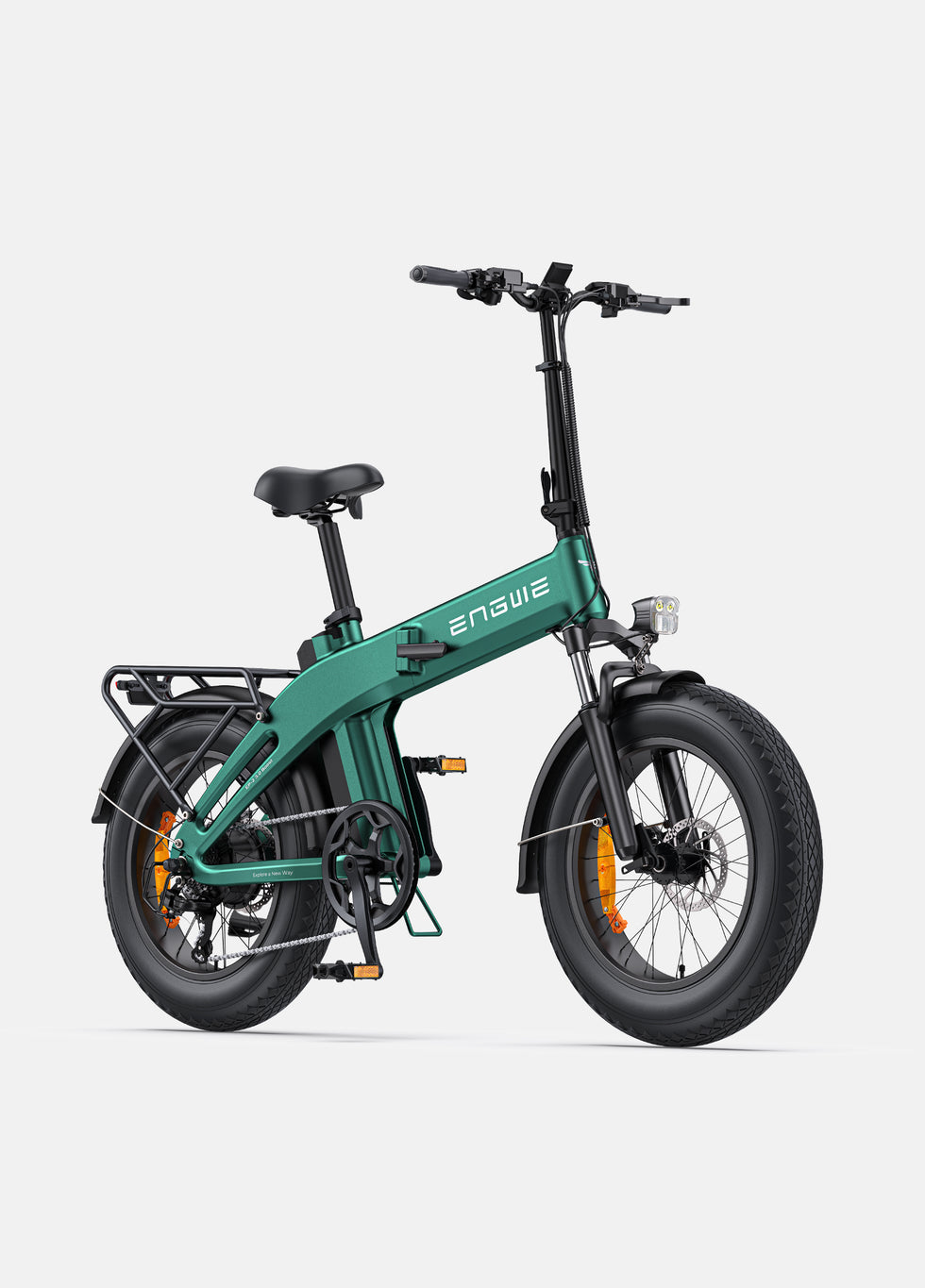
The ENGWE P20 fits this style of urban use. At 18.5 kg with 20-inch tyres and a 90 × 42 × 62 cm folded size, it combines folding capability with a format centred on daily city riding.
This type of rider should measure the spaces that matter most:
lift doorway → railway luggage area → office entrance → storage location
A few centimetres in the wrong dimension can matter more than a small difference in battery capacity.
Car Boot + Weekend Riding
Car transport changes the meaning of portability again.
If the bicycle only needs to be lifted into a vehicle at the beginning and end of a trip, minimum carrying weight may cease to be the dominant requirement.
Instead, riders can give greater weight to:
-
tyre volume;
-
suspension;
-
battery capacity;
-
riding distance;
-
braking equipment;
-
suitability for varied surfaces.
The Engine Pro 3.0 Boost is designed around that broader capability while retaining a folding frame. Its full suspension, 20 × 4.0-inch tyres, 720Wh battery and 90Nm torque support a different riding profile from a carry-focused city folder.
In this scenario, folding primarily helps the bicycle fit the transport and storage plan.
The bicycle does not need to behave like hand luggage to be useful.
Longer Routes and Mixed Surfaces
As riding distance increases, the balance between portability and ride capability shifts.
Battery capacity starts to affect how frequently charging must be planned. Tyre size affects how the wheels interact with imperfect surfaces. Suspension can reduce the amount of movement transferred directly from uneven ground to the rider and frame. Braking equipment becomes increasingly important as bicycle mass, gradients and varying terrain enter the journey.
This is where selecting among E Bike Brands purely on minimum weight can produce the wrong conclusion.
For mixed-surface rides, consider the complete system:
battery + assistance delivery + tyres + suspension + braking + folding dimensions
The Engine Pro 3.0 Boost combines a torque-sensing assistance system with a 720Wh battery, full suspension and wide tyres. The folding frame then adds a transport and storage function around that riding package.
For primarily urban journeys with more frequent folding, the Zip and P20 place their design emphasis differently.
The best match therefore depends on which part of the journey creates the constraint.
Which Folding E-Bike Brand Is Worth Considering?
The best e bike brands for folding portability are the ones that offer a design aligned with what the rider actually does after the frame folds.
There is no single definition of portability.
If the bike regularly travels up stairs or through stations, carry weight and folded footprint should dominate the shortlist.
If the bike mainly needs to fit into a flat or office, storage dimensions and everyday ride quality can carry more weight.
If folding is primarily required for a car boot, holiday accommodation or compact home storage, ride capability, battery capacity, tyres and suspension can become more important than minimum carrying weight.
ENGWE addresses these different requirements through distinct folding designs:
-
ENGWE Zip centres on frequent carrying and compact storage.
-
Engine Pro 3.0 Boost combines a folding frame with full suspension, wide tyres and a larger battery for riders whose priority shifts towards riding capability after transport or storage.
That is a more useful way to compare electric bike brands than simply asking which logo appears at the top of a ranking.
Start with your journey. Then choose the folding design that removes its biggest practical constraint.
Conclusion
Portability is not a single specification. It is the relationship between the folded bicycle and the journey around it.
For railway commuters and riders who regularly use stairs, low weight, compact dimensions and an efficient folding mechanism deserve priority. For urban riders with lifts and indoor storage, the balance can move towards ride quality and everyday practicality. For car transport or longer mixed-surface rides, folding can serve primarily as a storage function while battery capacity, tyres, suspension and braking take a larger role.
ENGWE reflects those different priorities across the Zip, P20 and Engine Pro 3.0 Boost rather than forcing one folding format to cover every journey.
Compare where you ride, where you store the bike and what happens between those two points. Then explore the ENGWE folding range to find the design that fits that routine.
FAQ
Are folding electric bikes allowed on trains in Germany?
Are folding electric bikes allowed on trains in Germany?
Yes, folded bicycles can be carried on Deutsche Bahn services as luggage when they are stored appropriately. Deutsche Bahn states that a folded bicycle can be taken as hand luggage without a bicycle ticket or bicycle-space reservation, provided it is safely stored and does not obstruct aisles, doors or safety equipment. Local transport associations may apply additional rules, so check every operator involved in your journey.
How heavy should a folding e-bike be if I need to carry it upstairs?
How heavy should a folding e-bike be if I need to carry it upstairs?
There is no universal weight threshold because carrying difficulty depends on your strength, the staircase and how often you lift the bike. For frequent carrying, compare complete bike weight, battery removability and the shape of the folded package. The ENGWE Zip weighs 16.9 kg without its battery, while its folding design is specifically oriented towards compact urban transport and storage.
Are 16-inch or 20-inch wheels more suitable for a folding e-bike?
Are 16-inch or 20-inch wheels more suitable for a folding e-bike?
Neither wheel size is universally preferable. Smaller wheels can help create a compact folded package, while larger wheels change the bicycle's packaging and on-road behaviour. The ENGWE Zip uses 16 × 1.95-inch tyres for a compact three-fold design, while the P20 uses 20 × 1.95-inch tyres in an urban folding format. Choose according to the balance you need between folded dimensions and riding requirements.
Does a folding e-bike need a removable battery?
Does a folding e-bike need a removable battery?
Not necessarily, but a removable battery can be useful for indoor charging and can separate some battery mass from the bicycle when required. It is particularly relevant for riders who cannot bring the complete bike near a power socket. The ENGWE Zip and P20 both use removable batteries, allowing the electrical energy storage component to be handled separately from the folded bicycle.
What should I check before buying a folding e-bike for a car boot?
What should I check before buying a folding e-bike for a car boot?
Measure the actual available boot opening and usable storage space, then compare those figures with the bike's folded dimensions. If frequent carrying is not required, also consider what happens after unloading: battery capacity, tyres, suspension and brakes may have greater practical value. A foldable model such as the Engine Pro 3.0 Boost combines reduced storage dimensions with full suspension, 20 × 4.0-inch tyres and a 720Wh battery.
Is a 250W folding e-bike suitable for normal road use in Germany?
Is a 250W folding e-bike suitable for normal road use in Germany?
A pedelec that meets the German bicycle definition can use pedal assistance with a maximum continuous rated power of 0.25 kW, with assistance progressively reducing and ending at 25 km/h or when pedalling stops. Other technical and road-use requirements still apply. Always check the specific German/EU version of a model rather than relying on specifications from another market.